

An Americanized 'Journey to the West' Emerges in San Francisco: Reflections on the Opera 'The Monkey King'
by Elizabeth Jia
Having attended the global premiere at the San Francisco Opera and reflected for less than twenty-four hours, those initially startling adaptations have begun to ferment in my mind, forming a peculiar aftertaste. This opera, with an almost reckless courage, has recast one of China's Four Great Classical Novels, Journey to the West, in the crucible of contemporary American culture. At first glance, it felt jarring; upon further thought, this seems to be the exact local flavor one might expect from an American version.
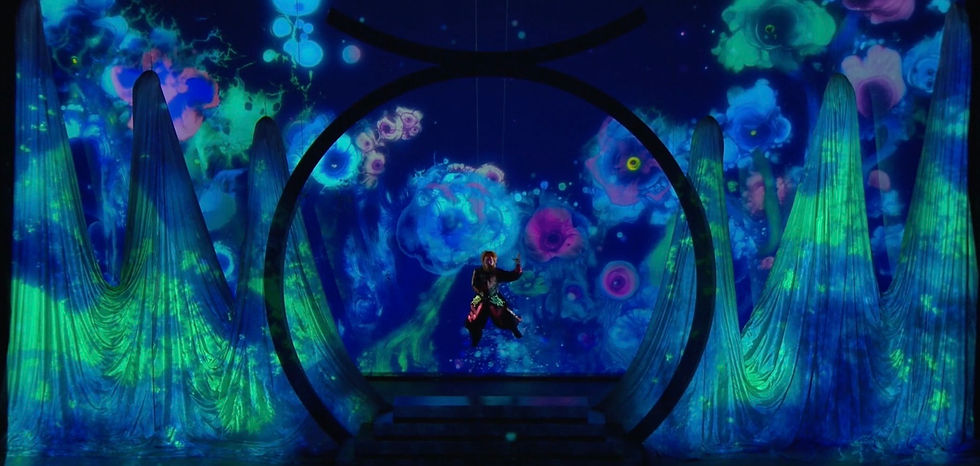
Starting with the positives: the use of Peking Opera gongs and drums adds an Eastern nuance to the traditional opera format. The incorporation of puppetry for Sun Wukong's cloning technique embeds traditional Eastern art forms, injecting the soul of Chinese aesthetics into this English-language opera. The set design for the Patriarch Subhuti scene comes closest to capturing the original's artistic conception.
However, when the gaze turns to the Celestial Court, the dilemmas of cultural translation become apparent.
The portrayal of the Jade Emperor abandons the dignified solemnity of traditional Chinese mythology, presenting him with an almost King of Hell-like ferocity. Laozi resembles a centipede demon, and the emphasis on the 'Gold' in Great White Planet Venus overlooks the 'White'. These character reconstructions reflect a Western imaginative interpretation of Eastern myths. Perhaps the most discomforting is the segment of the Bìmǎwēn (Stable Minister), where the horse puppets, resembling ghostly white cloth, tinge an originally humorous and lighthearted chapter with an unwarranted horror.

The boldest aspect of the adaptation lies in its turn towards political allegory. Guanyin Bodhisattva is the only bilingual character (Chinese and English) and is even capable of lecturing the Jade Emperor, directly stating, "Your rule has become corrupt, your heart clings only to wealth and power," and demanding he "promote virtuous kings and share resources." This plot point constitutes the greatest deviation from the original, yet also forms the core of the work's contemporary interpretation. The Jade Emperor's shift from hollow promises to ultimately confessing his own "corruption," along with dialogues infused with modern American context like "Why don't you go back to where you come from," connect this classic tale to modern issues such as immigration, equality, and checks on power.

Some character designs would indeed strike Chinese audiences as particularly cringeworthy. Erlang Shen transforms into a yellow-haired monster, the 'snake dance' design in the battle to capture Sun Wukong and the retrieval of the snake's gall come across as pure fabrication. The detail of a Heavenly King playing the pipa like a guitar exposes a crude, simplistic substitution of cultural symbols.
Yet, when Sun Wukong sings the brilliant aria declaring, "The Great Sage, Equal of Heaven, has been here!", all these controversies seem to find their reason for being. In that moment, what we witness is not merely the representation of a Chinese mythical hero, but a transoceanic,因地制宜 (locally adapted) reinvention of a classic work. Art serves politics.
The success of this production lies in how it has allowed a classic Chinese story to gain new vitality and contemporary relevance on the modern American stage.

In an era of deepening globalization, the attempt with The Monkey King reminds us that cultural dissemination is never a one-way output, but rather a dialogue full of creative misunderstandings and surprises. When Guanyin Bodhisattva traverses the Eastern and Western celestial realms bilingually, she connects not just two mythological worlds, but also two cultural ways of understanding the world.


Comments