

The Mirror of History and the Dream of the Future: The Modernist Reinvention and Cultural Politics of the Chicago World's Fair Edition of The Nutcracker by Joffrey Ballet
By Elizabeth Jia

Introduction: When Fairy Tale Meets Modern History
The melody of Tchaikovsky's The Nutcracker is solidified in Western cultural memory as the soundtrack of the Christmas season, much like drinking eggnog and eating Gingerbread men – a must-see ballet every holiday season, a production that sustains many ballet companies. However, Christopher Wheeldon's Chicago World's Fair edition of The Nutcracker for The Joffrey Ballet does not present the traditional dreamy romance of the Candy Kingdom. Instead, it thrusts us from the very beginning into the shacks of the World's Fair construction site during Chicago's harsh winter of 1892. This is not merely a change of scenery but a profound cultural operation: it transplants the romanticist core of Hoffmann's original tale into the underbelly of America's Gilded Age. This essay will dissect this cultural phenomenon from three dimensions. First, it will analyze how the ballet accomplishes the transformation from private fantasy to public allegory through the reconstruction of space, character, and dreamscape. Second, it will explore its impact on modern American society. Finally, it will focus on its most controversial and meaningful act of "historical correction" – particularly the foregrounding of Chinese elements and the silencing of the Japanese role – revealing how 21st-century artistic creation dialogues with history and politics.
Chapter One: Reconstructing the Classic – From the Candy Kingdom to the "White City" Utopia
1.1 The Politics of Space: From Parlor Privilege to Construction Site Democracy
The traditional Nutcracker unfolds within the enclosed space of a middle-class parlor. Magic is private, granted, revealed only to children of a specific class on Christmas Eve. The Chicago version shatters this privileged space, moving the stage to the shantytown beside the "White City" construction site (the buildings of the 1893 Chicago World's Fair were known as the "White City" a time when Chicago's demographic ratio was starkly unequal, with over 98% of the population being white. This spatial shift is revolutionary: it transforms the fairy tale's portal from a carpeted parlor to a drafty shack, transferring the ownership of magic from the privileged class to the children of immigrant laborers.

Marie – the daughter of a working-class family – does not drift into dreams from warmth and abundance but seeks solace from cold and deprivation. Her dream thus ceases to be mere escapism, becoming a compensatory imagination for structural deprivation, a collective psychological defense mechanism of an oppressed group. This precisely returns to the spiritual core of Hoffmann's original: in The Nutcracker and the Mouse King, Marie/Clara's fantasy is essentially a resistance against the instrumental rationality of the adult world. The Chicago version amplifies this resistance through a class lens, rendering dreams a potent weapon of spiritual resistance for the marginalized. However, regrettably, the choreography for this section is rather unremarkable. The trio's steps are often out of sync, one dancer consistently off, resulting in a visually unsatisfying experience. Despite the Joffrey Ballet likely having world-class dancers, impeccable discipline seems essential for achieving synchronicity. The costume design for this section is also notably plain, realistically reflecting the state of the working class and immigrants at the bottom of the social ladder, even during America's Gilded Age on its grandest Western holiday – a home decorated only with a small, crooked Christmas tree adorned with a single red ribbon.
1.2 Character Transformation: From Observer to Participant
Clara in the classical ballet is often seen as a passive "dream tourist," her primary function being to guide the audience through a series of exotic dances. The Chicago version's Marie is endowed with greater historical agency. The key to this transformation lies in the reorientation of the "Great Manager" role (modeled on Daniel Burnham, the fair's chief architect).
Drosselmeyer, in the traditional narrative, is the mysterious bestower of magic, while the "Great Manager" is a real-world dream engineer. He bridges two worlds: he is both the designer of the grand World's Fair blueprint and an intervener in Marie's impoverished reality. The Nutcracker, as a gift, undergoes a narrative arc of theft, breakage, and repair. This trajectory elevates it beyond a mere magical object, transforming it into a material medium connecting social strata. Its breakage metaphorizes the alienation of humanity in the industrial age. At the same time, its repair symbolizes social healing achieved through goodwill and cooperation – a modern variation on Hoffmann's theme of "transformation and redemption.”
1.3 The Ideology of the Dream: From Colonial Consumption to Civilizational Dialogue
The most subversive adaptation occurs in Act II. The classic "Candy Kingdom" is essentially a sweet reproduction of 19th-century colonial trade: dances representing coffee (Arabia), tea (China), and chocolate (Spain) are, in essence, European fantasies of consuming exotic resources. The Chicago version replaces this with the "Dream Fair," where performances from various national pavilions cease to be commodified exoticism and become egalitarian displays of civilizations.
Particularly noteworthy is the inclusion of "Buffalo Bill's Wild West Show." Historically, this performance did exist in the fair's "Midway Plaisance," creating a subtle tension with the "Court of Honor" in the main pavilions – on one side, the solemn display of European classical civilization; on the other, the spectacle-marketing of the American frontier. By retaining this element, the ballet not only adds historical authenticity but also introduces a critical interrogation of the power to define "civilization." Whose civilization is deemed "progressive"? Whose is displayed as "spectacle"? This conscious historical reflection elevates the dream journey beyond entertainment, turning it into an examination of modernity itself.
Chapter Two: Inspirations for Modern Sensibilities and the Vision Conveyed
2.1 Threefold Inspiration for Modern America
First, the reshaping of historical memory. The ballet insists on juxtaposing the glory of the "White City" with the hardship of the workers who built it, rejecting a singular ode to the "Progressive Era." The lesson for contemporary America is sharp: any technological leap or cultural spectacle, if not built upon a foundation of social equity, possesses a fragile brilliance. This dialectical view of history is particularly crucial today, amidst Silicon Valley miracles coexisting with crisis at the bottom of society.
Second, the de-elitization of cultural classics. By transplanting a European ballet classic into an immigrant worker context, the ballet essentially redefines "American identity": cultural resources should not be the exclusive domain of a privileged class but should become the shared heritage of diverse groups. This offers a constructive approach to America's intense current "culture wars" – the conflict between traditional canons and multiculturalism. It is not a matter of either/or replacement, but of creative fusion and expansion.
Third, the social engagement of high art. Ballet is often seen as a refined art form detached from reality, but this version proves that en pointe can bear the weight of heavy social issues. It pioneers a path for classical art to serve as a bridge across social divides rather than a wall of separation. The recent trend in American arts towards works focusing on marginalized groups finds a precursor here.
2.2 A Quartet of Core Ideas
The core message conveyed by the ballet can be summarized in four themes: The Democratization of Dreams: "Magic" does not belong to a specific class. A laborer's daughter has an equally sacred right to grand visions as a wealthy child. This expands the traditional American definition of "equal opportunity" beyond economic chance to encompass equal opportunity for imagination and spiritual vision.
Creation as Redemption: Whether it is Marie's mother sculpting the "Statue of the Republic" or the "Great Manager" designing the World's Fair, artistic and engineering creation is endowed with transcendent value. It suggests that solving social problems requires not only material redistribution but also communal spiritual construction and meaning-making.
The Dialectical Eye on History: The ballet does not deny technological progress or cultural achievement but insists that the audience simultaneously see the shadows behind these accomplishments – exploited laborers, excluded groups. This is an ethicized view of history, demanding that any nostalgia must incorporate a critical examination of injustice.
The Metaphor of Cross-Boundary Solidarity: The Nutcracker as a gift connects rich and poor; the World's Fair as a dream fuses diverse cultures. This provides a symbolic model of reconciliation for a highly fractured contemporary American society: social rifts may be bridged through concrete collaborative projects, shared cultural symbols, and common visions for the future.
Chapter Three: Historical Correction and Contemporary Dialogue – The Foregrounded China and the "Overlooked" Japan
3.1 The Historical Reality of 1893: China's Absence, Japan's Presence
To understand the profundity of the ballet's choice, one must return to the historical scene. When the 1893 Chicago World's Fair was held, the Qing government officially boycotted the event due to the United States' Chinese Exclusion Act (passed in 1882). This is a shameful page in American history and a scar in Sino-American relations. Meanwhile, Japan, rapidly Westernizing after the Meiji Restoration, became the most extensive and celebrated Asian presence at the fair, its pavilion seen as the modern representative of "Oriental civilization.”
The creators of the ballet were fully aware of this historical fact. Yet, in Marie's "Dream Fair," they made a bold, historically inaccurate choice: to place China at the visual and narrative center (from the opening news headline to the subsequent dragon dance) while making no mention of the actually participating Japan.
3.2 Art as Historical Arbiter: Compensatory Justice
This choice is first and foremost a symbolic correction of historical injustice. Through the power of art, the ballet creates a "parallel universe" for historical regret – in this dream, China, which should have participated, gains the cultural visibility and honored position it was denied at the time. The two dragons writhing across the ballet stage are not merely a visual spectacle but a grand compensation for historical absence. Art here exercises its privilege: when real history is filled with injustice, art can rewrite memory, dispensing a form of emotional justice. Of course, the portrayal of Chinese characters by white dancers could be improved. Incorporating elements of Chinese dance would be preferable; the current impression feels somewhat incongruous, with the red and blue color scheme appearing somewhat comical. However, this also reflects, in a way, that unofficial Chinese merchants and Chinese settlers residing in America did participate.
3.3 Twenty-First Century Cultural Politics: A Reflection of Contemporary Reality
More importantly, this choice is deeply rooted in the global reality of the 21st century. A ballet created in the contemporary era cannot divorce its perspective from the current cultural-political-economic landscape. China's re-emergence – not just in economic power, but in cultural confidence and global influence – is a context no contemporary creator can ignore. Placing Chinese elements in a prominent position, even if "historically inaccurate," is both a nod to the present cultural audience and a conscious adjustment of a Eurocentric historical view.
The ballet seems to be saying: the measure of a civilization's importance should not merely be its diplomatic standing or Western acceptance at a particular historical moment, but rather its culture's enduring vitality and lasting contribution to human civilization. From this perspective, China's "C-position" in the play is not a distortion of history but an acknowledgment of a broader, more long-term civilizational truth.
3.4 The "Dragon Dance" as a Symbol of Cultural Kinship
Introducing a "dragon dance" into the vocabulary of Western classical ballet is a highly impactful cultural hybrid. This choice sends a strong signal: this American ballet desires to establish a deep, physical kinship with Chinese culture. This connection transcends historical grievances, rising to an active cultural "drawing near." Establishing China's central presence on the visual level is itself a gesture of reconciliation and an invitation for the future.

3.5 The "Silent Treatment" of Japan: The Politics of Narrative
In contrast to the high-profile foregrounding of China is the "narrative silence" regarding Japan. This silence is equally pregnant with meaning: First, it is an implicit response and rebalancing of the historical phenomenon where Japan was seen in the Western eye as "replacing" China as the model of Eastern modernization. Second, it shifts the audience's attention from the realist historical question of "who was more welcomed by the West at the time" to the romanticist value question of "whose civilization is more worthy of eternal remembrance.” Third, in the contemporary geopolitical context, this choice is itself a clear expression of cultural positioning. It suggests that artistic narrative has the right – even the responsibility – to reconfigure the weight of historical material based on contemporary ethical and political considerations.
3.6 Art as Prophet of the Future
Through this series of operations, the ballet's core idea is elevated: art is not merely a recorder of history, but also its arbiter and a prophet of the future. It proclaims: official archives are not the only version of history. Art can construct a more ethical, more inclusive emotional history, in which the insulted gain dignity, the overlooked are acknowledged, and the excluded return to the center. Simultaneously, it transforms the ballet stage into a field for cross-temporal dialogue. The ballet extends a grand, artistic gesture of reconciliation from the 21st century towards the historical rift of the late 19th century. This is not only oriented towards the past but also towards the future, suggesting that dialogue between civilizations can transcend historical wounds, rebuilt upon mutual respect and appreciation.
Conclusion: Planting Dreams in Hard Reality, Breeding Reconciliation in Historical Wounds
The Chicago World's Fair edition of The Nutcracker becomes a landmark work precisely because it achieves a nearly impossible multi-layered balance: it is both exquisite classical ballet and sharp social commentary; it is both faithful historical representation and bold historical revision; it is both a quintessentially American story and a dialogue of global civilizations.
The contemporary fulfillment of this cultural project finds its ultimate, most convincing symbolic manifestation in the casting choices. In The Joffrey Ballet's 2025 production, Chinese dancer Ao Wang, as one of the company's principal artists, takes on the lead role of Marie. This casting decision, in multiple senses, represents the final symbolic completion and perfect execution of the entire ballet's cultural politics. Even if her name appears last in the cast list alphabetically, the fact that she is the undeniable leading role cannot be denied.
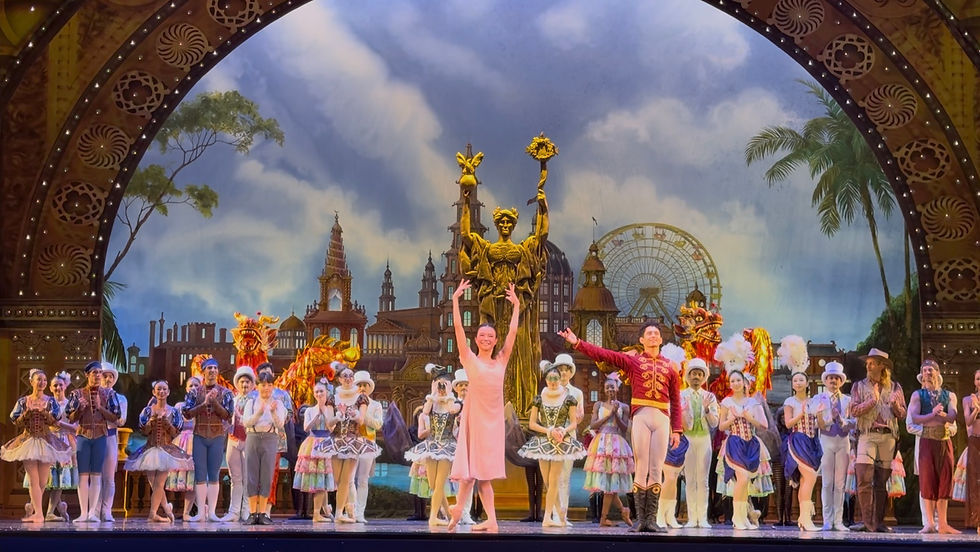
First, reality's confirmation of the dream. The ballet tells the story of a laborer's daughter, overlooked in reality, who gains dignity and power in her dreams. Ao Wang – a Chinese artist recognized in the contemporary global ballet world for her skill – standing on a Chicago stage, performing this story about a marginalized figure gaining a central position, is itself the real-world embodiment of the "democratization of dreams" theme. She proves that the doors of the artistic temple are opening to a wider world.
Second, contemporary healing of historical wounds. When a Chinese dancer, on stage, leads the audience into the dream of a World's Fair that once barred China's official entry, and witnesses the ascent of the "Chinese dragon" in the role of the protagonist, a profound historical reconciliation is taking place. This is not simple role allocation but a masterful symbolic act: the contemporary outstanding representative of a once-excluded civilization now, in a position of ownership, retells that history containing pain and exclusion, transforming it into a new story about inclusion and recognition.
Third, the embodiment of cultural dialogue. Ao Wang's performance is proof of cultural kinship beyond the "dragon dance" symbol, one that is more vibrant and vital. Her exquisite technique, her interpretation of the complex role of Marie, elevates the ballet's desired "deep connection with Chinese culture" beyond visual symbol, entering a deeper dimension of physical, emotional, and technical exchange. She is a living cultural envoy, infusing the rigorous framework of classical ballet with Eastern aesthetic sensibilities and emotional expression.
Therefore, the Chicago World's Fair edition of The Nutcracker ultimately reveals that the deepest power of art perhaps lies precisely in this: it can plant the most tender dreams in the hardest reality, and breed the most sincere reconciliation in the deepest historical wounds. When Marie's dream illuminates her dilapidated shack, when Chinese dragons soar above the dreamscape of the "White City," when Ao Wang, as a Chinese artist, breathes life into this American laborer's daughter on a Chicago stage, what we see is no longer merely a ballet. What we see is a profound allegory about art, memory, and redemption becoming reality.
In this era rife with division, nostalgia, and identity anxiety, this ballet and its contemporary performance offer a precious possibility: we can simultaneously critique the darkness of history and praise the human spirit; we can acknowledge wounds while building bridges; we can allow a laborer's daughter and her nutcracker, a once-excluded ancient civilization, and an artist representing the flow and fusion of a new era to jointly become indispensable protagonists in our collective dream.
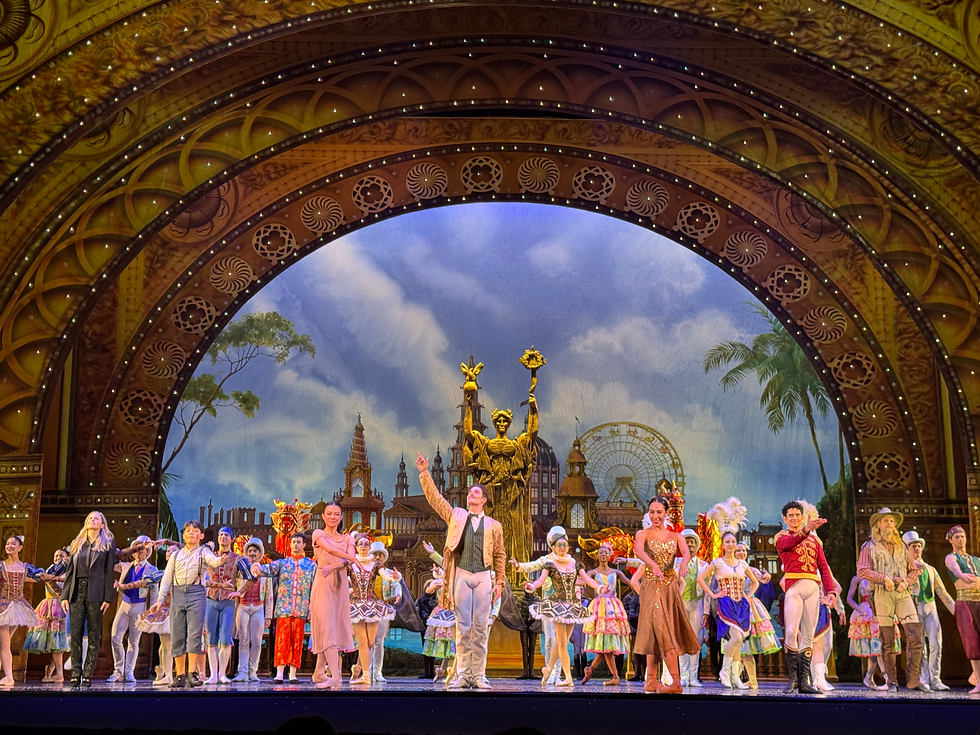
The true magic, as this ballet and its vibrant contemporary life enlightenment, perhaps lies not in the transformed prince, but in allowing every individual besieged by reality, every civilization once overlooked by history, to see their own reflection in the grand collective vision – and to believe that this reflection, however humble or once forgotten, deserves to be gently illuminated by the light of history, and embraced by the stage of our time.


Comments